Enhancing Industrial Networks with Legacy PLC Processing and Communication Modules
Introduction
Industrial automation relies heavily on durable hardware capable of operating continuously under demanding conditions. Many facilities utilize long-proven PLC components because of their stability, predictability, and compatibility with existing infrastructures. Two modules frequently found in these environments are the 140CPU43412AC processor and the NWBM85C002 bridge and multiplexer. When deployed together, these components support large-scale control architectures that depend on mixed communication methods, distributed I/O, and long-term operational reliability.
This article explains how the 140CPU43412AC and NWBM85C002 contribute to a flexible control system, their roles within industrial networks, and the operational advantages they provide.
The Foundation of Control: Processor Capabilities
Processing Requirements in Industrial Automation
The main processor executes logic, schedules tasks, and maintains deterministic cycle behavior across the control system. A stable CPU ensures consistent scan times and predictable interaction with both local and remote I/O. The 140CPU43412AC is widely used for this purpose because of its dependable runtime characteristics and compatibility with modular rack systems.
Systems that require large I/O counts and continuous operation benefit from a processor like the 140CPU43412AC, which is capable of managing structured communication and multiple data exchanges without compromising performance.
Why Proven Processors Remain Common
The 140CPU43412AC remains active in many industrial environments due to several practical features:
- Compatibility with legacy racks and modular hardware
- Stable real-time processing behavior
- Support for established industrial buses
- Long, proven service life in demanding facilities
Its predictable scan cycle and broad communication support make the 140CPU43412AC a dependable core component for distributed industrial systems.
Communication Infrastructure and Its Role
Communication as a Core Function
Efficient communication ensures that all devices within a plant transmit and receive data reliably. When field devices use a mixture of serial protocols and bus-based communication, the system requires hardware that can unify these networks without causing delays or data integrity issues.
This is where the NWBM85C002 becomes valuable.
Purpose of a Bridge and Multiplexer in a Control Network
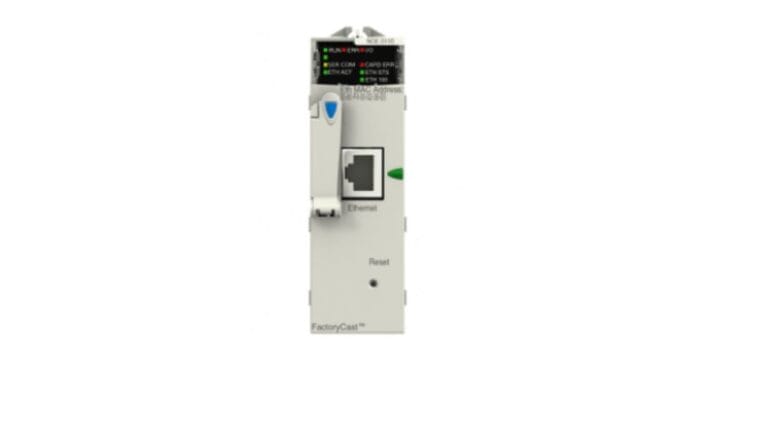
Many facilities still operate older serial devices such as instrumentation, operator terminals, and standalone controllers. These devices cannot directly communicate on modern high-speed networks. The NWBM85C002 acts as a bridge, bringing serial equipment into the main control system without costly replacements.
The configurable ports on the NWBM85C002 allow it to route multiple streams of serial data into a unified network, making it an essential module for plants with mixed-generation equipment.
System Architecture Using Both Modules
Structured Connectivity
Pairing the 140CPU43412AC with the NWBM85C002 results in a structure where responsibilities are clearly separated. The processor executes logic and manages I/O processing, while the communication bridge handles protocol conversion and serial-device integration.
A typical system layout includes:
- The 140CPU43412AC handling logic execution and I/O coordination
- The NWBM85C002 managing serial communication paths
- A backbone bus linking remote racks, SCADA systems, and HMIs
This arrangement keeps communication organized and prevents unnecessary load on the processor.
Benefits of a Combined Control and Communication Setup
Using both the 140CPU43412AC and the NWBM85C002 within the same network offers:
- Efficient CPU utilization: The NWBM85C002 handles protocol translation instead of the processor.
- Support for legacy serial equipment: Older devices integrate seamlessly without system redesign.
- Improved communication reliability: Data is routed through a dedicated, stable module.
- Scalability and easy expansion: Additional devices and I/O drops can be added with minimal changes.
This combination is especially useful in mixed-technology systems where both modern and legacy devices must operate together.
Real-World Integration Scenarios
Legacy Device Retention
Older serial devices often remain in service because they still function reliably. Replacing them can be costly and unnecessary. With the NWBM85C002, these devices interface smoothly with the main control system. The 140CPU43412AC continues to execute logic operations, while the bridge efficiently routes serial communication.
Incremental System Upgrades
Plant expansions often occur in stages. Adding new panels, I/O points, or equipment does not require replacing older communication structures. The 140CPU43412AC manages the expanded control load, and the NWBM85C002 ensures that legacy devices are still fully integrated.
Distributed Operations and Remote I/O
Large facilities rely on distributed I/O systems to reduce wiring and simplify local maintenance. The 140CPU43412AC maintains deterministic scan timing across remote racks, while the NWBM85C002 links serial devices located throughout the plant, helping maintain consistent communication across diverse equipment.
Longevity and Operational Stability
Long-Term Operation in Tough Conditions
Industrial plants often run continuously, and hardware must maintain performance despite temperature variations, dust, vibration, and electrical noise. Both the 140CPU43412AC and the NWBM85C002 have strong reputations for operating reliably in such environments.
Predictable Behavior Over Time
Predictability reduces troubleshooting time and supports long-term system planning. The 140CPU43412AC delivers consistent control cycles, while the NWBM85C002 maintains dependable communication handling. Together, they help create stable systems with minimized downtime.
Final Thoughts
A reliable automation system requires stable processing, strong communication, and compatibility across a wide range of equipment. Using a processor like the 140CPU43412AC alongside a communication module such as the NWBM85C002 helps facilities maintain effective control over complex networks that combine legacy and modern devices.
These components allow plants to integrate older equipment, expand their systems in phases, and maintain long-term operational stability. Their performance, reliability, and compatibility make them valuable elements in industrial environments where uptime and consistency are critical.