Industrial Circuit Breakers: 5 Things to Check Before Ordering a Replacement
A breaker that won’t reset, or one that’s tripping for no obvious reason, is one of the more stressful faults to troubleshoot, because it sits right at the intersection of safety and downtime. Get the replacement wrong and you’re either back at square one or, worse, running a circuit with the wrong level of protection.
Sourcing industrial circuit breakers correctly means understanding more than just the physical frame size. Trip curve, interrupting rating, and accessory configuration all have to match the application, not just the panel cutout.
Why Industrial Circuit Breakers Aren’t a Simple Swap
Breakers from different manufacturers, and even different families from the same manufacturer, aren’t interchangeable just because they share a similar current rating. A molded case breaker rated for general distribution protection behaves very differently from a motor protection breaker designed specifically to handle motor inrush current without nuisance tripping.
That distinction matters more than people expect when sourcing industrial circuit breakers, because a breaker that trips too early, or not early enough, isn’t just an inconvenience. It’s a protection scheme that no longer matches what the circuit actually needs.
Quick Comparison: Breaker Types at a Glance
| Breaker Type | Primary Use | Trip Behavior | Common Mistake |
|---|---|---|---|
| Molded Case (MCCB) | General distribution, feeders, panels | Standard inverse-time trip curve | Used on a motor circuit, causing nuisance trips at startup |
| Motor Protection | Motor branch circuits | Tolerates brief inrush current, protects against overload/short circuit | Substituted with a standard MCCB, missing motor-specific protection |
| Miniature (MCB) | Lighting, control circuits, small loads | Fast trip, lower current ratings | Used on higher-current industrial loads it wasn’t rated for |
1. Confirm Frame Size and Trip Rating Together
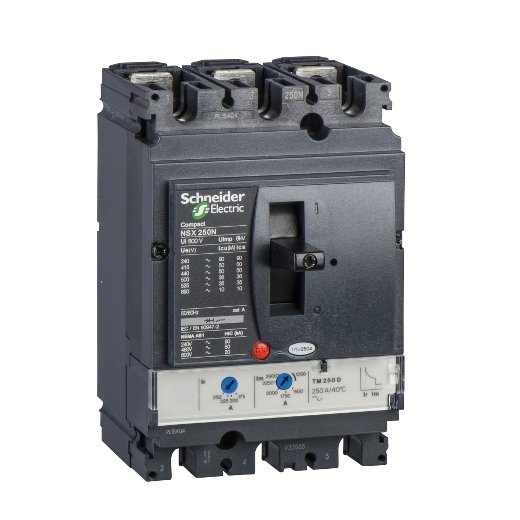
Frame size determines the physical envelope a breaker fits into, but trip rating determines what current it actually protects against. A Compact NSX circuit breaker is a good example of hardware where the frame size covers a range of trip ratings, so confirming both numbers together matters more than checking either one in isolation.
Installing a breaker with the correct frame but the wrong trip setting either leaves a circuit under-protected or causes it to trip well before it should under normal load conditions.
2. Match Interrupting Rating to Your System’s Fault Current
Interrupting rating is one of the most overlooked specs in breaker replacement, and it’s also one of the most important from a safety standpoint. This rating defines how much fault current the breaker can safely interrupt without failing catastrophically.
An ABB molded case breaker and a similarly rated unit from another manufacturer might look interchangeable on paper, but interrupting ratings can differ significantly between product lines. Always verify this against your system’s available fault current, not just the breaker’s continuous current rating.
3. Use Motor Protection Breakers for Motor Circuits Specifically
Standard distribution breakers and motor protection breakers serve different purposes, even when their current ratings overlap. Motor circuits experience a brief but significant inrush current at startup that a standard breaker may interpret as a fault condition, causing nuisance trips.
A motor protection circuit breaker is built with a trip curve specifically shaped to tolerate that startup inrush while still protecting against genuine overload and short circuit conditions. Substituting a standard breaker into a motor circuit is a common cause of trips that seem to happen for no clear reason.
4. Check Accessory Compatibility Before Ordering
Many industrial breakers support accessories like auxiliary contacts, shunt trips, and undervoltage releases, and these accessories are often specific to a particular breaker frame and series. Ordering a replacement breaker without also confirming that your existing accessories will fit, or that a matching accessory is available for the new unit, can leave you with a functional breaker but a non-functional control or monitoring circuit.
This is especially worth checking on breakers tied into remote trip or monitoring systems, where a mismatched accessory can silently disable a feature the rest of the system is relying on.
5. Buy From a Supplier Who Can Verify the Full Specification
Circuit breaker nameplates carry a lot of information in a small space, frame size, trip rating, interrupting rating, and accessory configuration all packed together. A supplier who can read and confirm the full specification against your application reduces the risk of ordering something that looks right but isn’t actually correct for the circuit.
Reach out through the contact page if you’re working from a faded nameplate or incomplete documentation and need help confirming an exact match before ordering.
For general background on how these devices are classified and rated, the Wikipedia overview of molded case circuit breakers is a useful primer, and Schneider Electric’s own Compact NSX product documentation is worth checking for exact specs before you order.
Frequently Asked Questions
Q: Can I use a higher interrupting rating breaker than what’s technically required?
A: Yes, using a breaker with a higher interrupting rating than the minimum required is generally safe and sometimes recommended as a margin of safety. The risk runs the other direction, using a breaker rated below your system’s available fault current.
Q: Why does my motor circuit keep tripping a standard breaker at startup?
A: This is a classic sign that a standard distribution breaker is installed where a motor protection breaker should be. The inrush current at motor startup is normal, but a standard breaker’s trip curve may interpret it as a fault.
Q: Do circuit breaker accessories need to match the exact breaker model?
A: In most cases, yes. Accessories like shunt trips and auxiliary contacts are typically designed for a specific breaker frame and series, so a mismatch can prevent the accessory from functioning correctly even if the breaker itself works fine.
Q: How do I find the interrupting rating on an existing breaker?
A: It’s usually printed on the breaker’s nameplate, often labeled as AIC (amps interrupting capacity) or a similar designation. If the nameplate is worn or missing, the manufacturer’s documentation for that model and frame size will list it.
Replacing industrial circuit breakers correctly means matching frame size, trip rating, and interrupting rating together, not just picking something that fits the same physical space. Use motor-rated breakers on motor circuits specifically, verify accessory compatibility, and confirm the full specification with a supplier before you order.