TeSys Contactor Parts: 5 Things to Check Before Replacing a Failed Contactor
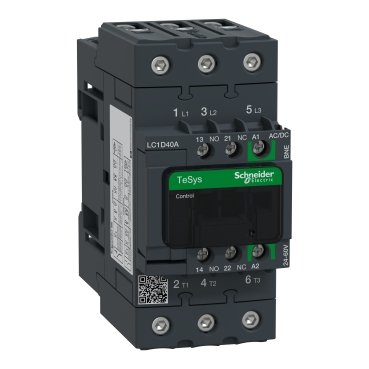
Contactors don’t get the attention that PLCs and drives do, but they’re one of the most frequently replaced components in any motor control panel. Contacts wear from repeated switching, coils burn out from overvoltage or age, and eventually every contactor reaches the end of its service life.
The problem is that TeSys contactor parts look deceptively simple to replace. Grab something the right physical size, bolt it in, done, except coil voltage, contact rating, and auxiliary configuration all have to match too, or the replacement either won’t work or won’t last.
Why TeSys Contactor Parts Get Mismatched So Often
Schneider’s TeSys line spans several series, D, F, and others, each covering a different range of current ratings and frame sizes. Within any given series, the same physical footprint can house contactors rated for very different coil voltages and contact configurations.
That’s exactly why ordering TeSys contactor parts based on frame size alone is risky. A contactor that fits the same panel cutout and mounting rail can still be completely wrong for the application if the coil voltage or contact rating doesn’t match what the circuit actually needs.
1. Confirm Coil Voltage Before Anything Else
This is the single most common mistake in contactor replacement. Coil voltage has to match your control circuit exactly, 24V, 110V, and 230V coils are not interchangeable, and installing the wrong one either won’t energize the contactor at all or will damage the coil almost immediately.
A TeSys D-line contactor is a good example of hardware where the coil voltage designation is built into the part number itself, so double-check that suffix against your existing part rather than assuming a similar-looking unit will match.
2. Match Contact Rating to the Actual Load
Current rating matters just as much as coil voltage. A contactor sized for a smaller motor won’t handle the inrush current of a larger one, and running it near or above its rated capacity accelerates contact wear dramatically, shortening the replacement’s life far below what you’d expect.
A TeSys F-line contactor sits at the higher end of the current range and is a good example of hardware sized specifically for larger motor loads, not something to substitute in for a smaller, lower-rated unit just because it happens to be in stock.
3. Check Auxiliary Contacts and Accessories Separately
Many contactor failures aren’t the main power contacts at all, they’re an auxiliary contact block or an accessory component that’s worn out or come loose. Pushbuttons and pilot devices wired into the same control circuit, like a TeSys pushbutton, are also common points of failure that get misdiagnosed as a contactor problem.
Before replacing an entire contactor, it’s worth checking whether the actual fault is in an auxiliary block, a pushbutton, or the wiring between them, since these smaller components are cheaper and faster to replace.
4. Consider Safety Relay Requirements on Guarded Circuits
If the contactor is part of a safety-related circuit, such as an emergency stop or guard interlock, replacing it isn’t just about matching coil and contact ratings. A safety relay module monitoring that circuit needs to see the correct feedback signal from the contactor, and mismatched or incompatible auxiliary contacts can prevent the safety circuit from resetting properly even if the contactor itself is functioning.
This is worth flagging early in the replacement process, since a safety circuit that won’t reset after a contactor swap is a common and avoidable source of unplanned downtime.
5. Buy From a Supplier Who Can Confirm the Full Part Number
TeSys part numbers pack a lot of information into a short string, series, frame size, coil voltage, and configuration all encoded together. A supplier who understands the platform can confirm you’re ordering the exact match rather than something that only looks similar on a shelf, especially on older installations where the original documentation may not be complete or accurate anymore.
For general background on how contactors function within a motor control circuit, the Wikipedia overview of contactors is a solid primer, and Schneider Electric’s own TeSys product documentation is the best source for confirming exact specs before ordering.
Frequently Asked Questions
Q: Can I use a higher-rated contactor than what the application actually needs?
A: Generally yes from a functional standpoint, oversizing a contactor for its load usually just means a longer service life. The bigger risk is undersizing, which accelerates contact wear and can cause premature failure.
Q: Why does my new contactor chatter or hum when it’s supposed to be energized?
A: This often points to a coil voltage mismatch or low control voltage reaching the coil, rather than a defective contactor. Check the coil rating against your actual measured control voltage before assuming the part itself is faulty.
Q: How do I know if a contactor failure is actually an auxiliary contact issue?
A: If the main contacts are switching correctly but a status signal, interlock, or indicator isn’t behaving as expected, the auxiliary block is a more likely cause than the contactor’s main power contacts. These can often be tested or replaced independently.
Q: Do safety-rated contactors need to be replaced with the exact same model?
A: It’s strongly recommended. Safety circuits are often certified as a complete system, including the contactor’s feedback contacts, and substituting a similar but non-identical part can affect the safety function even if it appears to work normally.
Replacing TeSys contactor parts correctly means matching coil voltage and contact rating exactly, not just physical size. Check auxiliary contacts and safety relay feedback before assuming the main contactor is the only faulty component, and confirm the full part number with a supplier who knows the platform.