Prevent Electrical Surges During Startup With Innovative Motor Protection Solutions
Every time an induction motor starts across the line, it draws several times its rated running current — often six to eight times full-load amps for a fraction of a second. That inrush current creates a voltage sag on the supply, mechanical shock on the motor and connected load, and cumulative wear on switchgear. In facilities with multiple large motors, uncoordinated starts can create surges significant enough to disrupt sensitive equipment elsewhere on the same electrical system. Fortunately, modern motor protection solutions are specifically designed to reduce this stress.
Why Startup Surges Happen
When an induction motor is energized directly across the line, the rotor is stationary and offers very low impedance, so the motor briefly behaves almost like a short circuit until it accelerates toward running speed. This inrush current is a normal characteristic of induction motors, but it becomes a problem when:
- Multiple motors start simultaneously on a shared feeder
- The supply transformer is undersized relative to total connected motor load
- Mechanical loads have high starting torque requirements
- Frequent starts accelerate wear on contacts and windings
Soft Starters: Controlled Voltage Ramp-Up
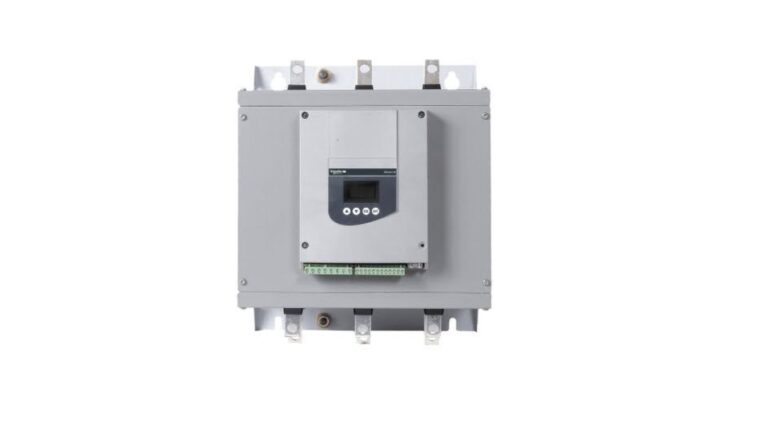
Soft starters reduce inrush current by gradually ramping applied voltage up to full line voltage over a configurable time period, rather than applying full voltage instantly. This significantly reduces both electrical and mechanical stress during acceleration.
Units such as the ATS48 soft starter and ATS22 soft starter series allow ramp time, current limit, and torque control to be tuned to the specific load, which is particularly valuable for pumps, fans, and conveyors where mechanical shock during startup can damage couplings or belts.
Variable Frequency Drives for Full Control
Where soft starters manage voltage during acceleration only, variable frequency drives (VFDs) control both voltage and frequency continuously, giving much finer control over motor behavior from a complete stop through full speed and back down again. VFDs like the ATV930 series and ATV71 drives essentially eliminate the traditional inrush current spike because the motor never sees a step change in applied voltage.
VFDs also bring the added benefit of process control — speed regulation, energy savings at partial load, and built-in diagnostics. If you’re troubleshooting drive-related startup faults, our guide on common F004 fault causes in Siemens VFDs covers related diagnostic steps.
Overload and Thermal Protection as a Second Layer
Even with controlled starting, motors still need thermal protection against sustained overcurrent conditions from mechanical binding, voltage imbalance, or single-phasing. Thermal overload relays such as the LTMR08PBD provide this layer of protection independent of the starting method, and should be sized to the motor’s actual full-load current, not the starter’s rated output.
Sequencing Multiple Motor Starts
In facilities with several large motors on a shared feeder, staggering start times — either through PLC-controlled sequencing or built-in soft starter timers — prevents cumulative inrush current from multiple simultaneous starts stacking up and causing a larger voltage dip than any single motor would cause alone.
Choosing the Right Protection Strategy
The right approach depends on load type, starting frequency, and how much process control is needed:
- Occasional starts, simple loads: Soft starter with overload relay
- Frequent starts, variable speed needs: VFD
- High-inertia loads (large fans, crushers): VFD or soft starter with extended ramp and current-limit settings
- Multiple motors on shared feeder: Sequenced starting plus individual soft starters or VFDs
Frequently Asked Questions
Q: What’s the difference between a soft starter and a VFD for reducing startup surges? A: A soft starter controls voltage only during acceleration and deceleration, while a VFD continuously controls both voltage and frequency, offering finer control and ongoing speed regulation after startup.
Q: Can a soft starter alone protect a motor from overload conditions? A: No — soft starters manage the starting ramp, but a dedicated thermal overload relay is still needed for continuous overcurrent protection.
Q: How much can a soft starter reduce inrush current? A: Depending on configuration, soft starters can reduce inrush current from roughly 6–8 times full-load amps down to 2–4 times, though exact figures depend on load and settings.
Q: Do all motors need surge protection at startup? A: Small motors on adequately sized supplies often start across the line without issue. Surge protection becomes more important as motor size increases or when multiple motors share a feeder.